




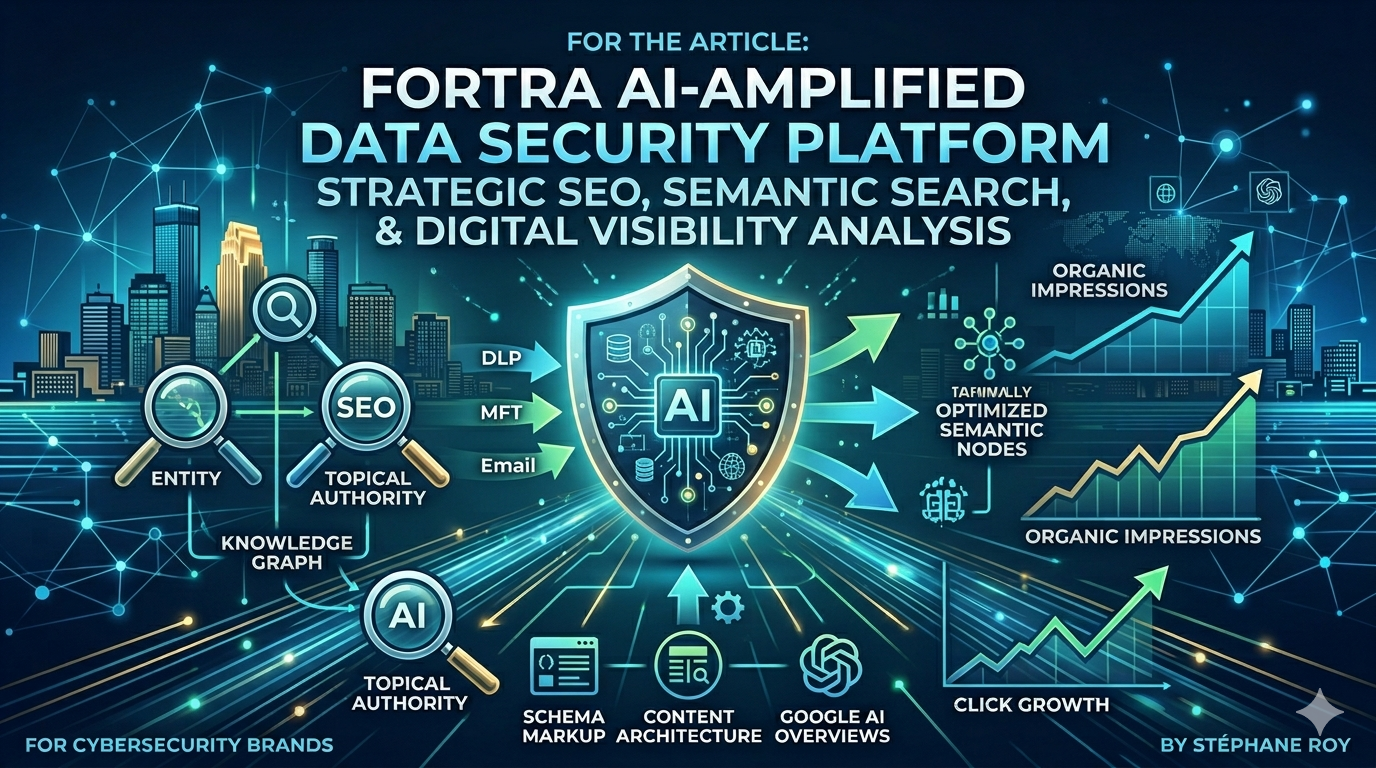
Fortra AI-Amplified Data Security Platform Review: Cybersecurity, AI Security & Enterprise Data Protection Analysis (2026)
Independent Research Notice: This analysis was prepared for educational and strategic research purposes based on publicly available information regarding Fortra, its cybersecurity platform, product ecosystem, and digital market positioning.
By Stéphane Roy | Semantic SEO Consultant | AI Search Strategist
Author Expertise & Research Methodology
This independent analysis was prepared by Stéphane Roy, a Canadian Semantic SEO Consultant, AI Search Strategist, Technical SEO Specialist, and Digital Marketing Consultant specializing in enterprise search visibility, cybersecurity content architecture, structured data, entity optimization, and AI discovery systems.
The analysis is based on publicly available information regarding Fortra’s cybersecurity platform, product ecosystem, market positioning, and digital presence. It was conducted from the perspective of enterprise search visibility, semantic authority, AI search optimization, and cybersecurity market analysis.
Fortra Minneapolis, Minnesota: Enterprise Cybersecurity Leadership in 2026
Fortra, headquartered in Eden Prairie, Minnesota within the Minneapolis–Saint Paul metropolitan area, has evolved into one of the cybersecurity industry’s most diversified enterprise security platforms. Formerly known as HelpSystems, the organization now delivers a comprehensive portfolio spanning data protection, managed file transfer, email security, threat intelligence, vulnerability management, compliance automation, and AI security.
As organizations increasingly adopt artificial intelligence, cloud-native infrastructures, and hybrid work environments, the need for integrated cybersecurity solutions continues to grow. Through technologies such as GoAnywhere MFT, Digital Guardian, Tripwire, Alert Logic, and Cobalt Strike, Fortra provides enterprise organizations with a unified approach to managing cyber risk, protecting sensitive information, and strengthening operational resilience.
This independent analysis explores Fortra’s cybersecurity platform, digital authority, enterprise positioning, AI security strategy, and long-term growth opportunities within the evolving cybersecurity landscape.
Executive Summary
Enterprise cybersecurity has entered a new era where data, AI, compliance, and digital trust are now inseparable.
Traditional perimeter defenses, standalone security tools, and fragmented technology stacks are no longer sufficient to protect organizations operating within cloud-first, AI-enabled, and highly interconnected digital environments.
In 2026, organizations face a growing challenge: securing data that moves continuously across applications, cloud infrastructures, remote workforces, artificial intelligence platforms, supply chains, and global business ecosystems.
Against this backdrop, Fortra has emerged as one of the most interesting companies in the cybersecurity industry.
Formerly known as HelpSystems, Fortra has transformed itself into a comprehensive cybersecurity platform that combines data protection, managed file transfer, email security, threat intelligence, vulnerability management, digital risk protection, and AI security capabilities into a unified ecosystem.
This analysis examines Fortra from multiple perspectives:
- Cybersecurity strategy
- Enterprise data protection
- AI security readiness
- Digital authority
- Semantic SEO
- Content architecture
- Competitive positioning
- Future growth opportunities
The goal is not to evaluate Fortra as a job candidate or marketing partner, but rather to provide an independent analysis of how the company is positioned within today’s cybersecurity landscape and how its digital ecosystem aligns with the future of enterprise security.
The Evolution of Fortra: From HelpSystems to Cybersecurity Platform
One of the most important aspects of understanding Fortra is understanding its evolution.
Many organizations know the company by its former name: HelpSystems.
For decades, HelpSystems built a reputation for enterprise software, systems management, automation, managed file transfer, and security-related technologies.
As cybersecurity threats evolved and enterprise requirements expanded, the company adopted a broader vision.
Rather than operating as a collection of disconnected software products, the organization began consolidating multiple cybersecurity disciplines under a single strategic identity.
The result was Fortra.
This transition represented far more than a rebrand. It represented a shift toward becoming a full-scale cybersecurity ecosystem capable of serving enterprise organizations across multiple security domains.
Today, Fortra operates across several major cybersecurity pillars:
- Data Protection
- Data Loss Prevention (DLP)
- Managed File Transfer (MFT)
- Email Security
- Threat Intelligence
- Vulnerability Management
- Managed Detection & Response
- Digital Risk Protection
- Compliance Automation
- Security Awareness Training
- AI Security
This diversified portfolio has positioned Fortra among the most comprehensive cybersecurity vendors in the industry.
What Is the Fortra AI-Amplified Data Security Platform?
The Fortra AI-Amplified Data Security Platform is designed around a simple but increasingly important principle:
Data is the new security perimeter.
Traditional security models focused primarily on networks, devices, and physical boundaries. Modern organizations operate differently.
Sensitive information now exists across:
- Cloud applications
- SaaS platforms
- AI systems
- Employee devices
- Third-party vendors
- Collaboration tools
- Data warehouses
- Hybrid infrastructures
Fortra’s platform attempts to unify security visibility and governance across these environments.
Core Capabilities
- Data Protection: Protecting sensitive information regardless of where it resides.
- Data Loss Prevention: Monitoring, classifying, and preventing unauthorized data exposure.
- Managed File Transfer: Ensuring secure, auditable, and compliant data exchange.
- Email Security: Protecting organizations against phishing, malware, ransomware, and business email compromise.
- Threat Intelligence: Providing visibility into emerging threats and attack patterns.
- AI Security: Addressing risks associated with AI adoption, governance, and data exposure.
The platform’s primary strength lies in its ability to bring multiple cybersecurity disciplines together within a unified operational framework.
Core Product Ecosystem
One of Fortra’s greatest competitive advantages is the breadth of technologies operating under its umbrella.
GoAnywhere MFT
GoAnywhere Managed File Transfer is one of Fortra’s most recognizable enterprise solutions. It allows organizations to securely exchange sensitive files, automate data transfers, maintain compliance, reduce operational risk, and improve visibility into data movement.
Digital Guardian
Digital Guardian strengthens Fortra’s position within the Data Loss Prevention market through data classification, data monitoring, endpoint protection, cloud data protection, and insider threat detection.
Tripwire
Tripwire is widely recognized within vulnerability management, configuration monitoring, file integrity monitoring, compliance monitoring, and vulnerability assessment.
Alert Logic
Alert Logic enhances Fortra’s Managed Detection and Response capabilities through continuous monitoring, threat detection, incident response, and cloud security monitoring.
Cobalt Strike
Cobalt Strike enables adversary simulation and offensive security testing designed to help organizations evaluate and strengthen their defenses.
Enterprise Data Protection Strategy
Data protection remains one of the strongest pillars of Fortra’s cybersecurity positioning.
This focus aligns closely with how enterprise security priorities have evolved. Organizations are increasingly concerned about sensitive customer information, intellectual property, financial data, healthcare records, AI training data, and confidential business information.
Fortra’s approach combines data classification, DLP, secure transfer, compliance management, and threat detection into a unified strategy designed to reduce enterprise risk.
AI Security & Emerging Risks
Artificial intelligence represents one of the most significant cybersecurity developments of the decade.
AI creates opportunities, but AI also creates risk.
Prompt Injection
Manipulating AI systems through malicious instructions.
Shadow AI
Employees using unauthorized AI tools without governance.
Data Leakage
Sensitive information accidentally exposed through AI systems.
Model Manipulation
Attempts to influence AI outputs or compromise model integrity.
AI-Powered Phishing
Sophisticated social engineering attacks generated at scale.
Compliance Challenges
Regulatory concerns surrounding AI data handling.
Fortra’s positioning around AI security reflects a growing recognition that enterprise cybersecurity must evolve alongside artificial intelligence.
Fortra Minneapolis: Regional Authority & Global Reach
Fortra is headquartered in Eden Prairie, Minnesota, within the Minneapolis–Saint Paul metropolitan area. As one of the region’s most recognized cybersecurity software organizations, the company has evolved into a global provider of enterprise security solutions spanning data protection, threat intelligence, managed file transfer, email security, compliance automation, and AI security.
Search terms such as Fortra Minneapolis, Fortra Minnesota, and Fortra Headquarters are increasingly associated with cybersecurity innovation, enterprise software leadership, and digital transformation initiatives.
From a digital authority perspective, the association between Fortra and the Minneapolis technology ecosystem reinforces both regional credibility and broader enterprise trust signals across search engines, knowledge graphs, and AI-powered discovery platforms.
Global Presence & Enterprise Reach
While headquartered in Minnesota, Fortra serves enterprise organizations across North America, Europe, Latin America, and the Asia-Pacific region. This international footprint enables the company to support organizations operating across multiple regulatory frameworks, compliance environments, and cybersecurity maturity levels.
Competitive Analysis
While many cybersecurity vendors specialize in a single security category, Fortra differentiates itself through a platform approach that combines data protection, managed file transfer, email security, vulnerability management, compliance automation, and AI security capabilities within a unified ecosystem.
Fortra vs CrowdStrike
CrowdStrike is primarily associated with endpoint security. Fortra offers a broader portfolio focused on data protection, file transfer, compliance, and risk management.
Fortra vs Palo Alto Networks
Palo Alto Networks dominates network security discussions. Fortra differentiates itself through its emphasis on protecting data rather than focusing exclusively on network infrastructure.
Fortra vs Microsoft Security
Microsoft benefits from ecosystem integration. Fortra provides specialized solutions capable of operating across heterogeneous enterprise environments.
Fortra vs Proofpoint
Proofpoint maintains strong authority within email security. Fortra expands beyond email into managed file transfer, DLP, vulnerability management, and operational security.
Semantic SEO & Digital Authority Analysis
From a semantic search perspective, Fortra possesses a strong entity ecosystem.
- Data Protection: Data Security, DLP, Governance, Compliance
- Secure Data Exchange: Managed File Transfer, Secure Communications, Automation
- Email Security: Phishing Protection, BEC Prevention, Threat Detection
- Threat Intelligence: Threat Research, Digital Risk Protection, Security Operations
- AI Security: AI Governance, AI Risk Management, AI Data Protection
These interconnected entities strengthen both organic search visibility and AI citation potential.
Strategic Growth Opportunities
As enterprise search evolves toward AI-generated answers, entity-based discovery, and conversational search experiences, Fortra has multiple opportunities to further strengthen its cybersecurity authority and digital visibility.
Knowledge Graph Optimization
Strengthening relationships between products, cybersecurity disciplines, industries, compliance frameworks, and enterprise use cases can improve entity recognition and reinforce Fortra’s position within search engines and AI-powered knowledge systems.
AI Citation Readiness
As AI answer engines increasingly cite trusted sources, structuring product documentation, technical resources, and educational content around clearly defined entities can improve citation opportunities across AI-powered discovery platforms.
Content Architecture
Expanding content clusters around AI governance, cyber resilience, secure data exchange, data sovereignty, and security automation can strengthen topical authority while supporting future enterprise search demand.
Schema & Structured Data
Advanced structured data implementation can improve machine readability, strengthen Knowledge Graph relationships, and enhance how Fortra’s expertise is interpreted by both traditional search engines and emerging AI systems.
Why This Analysis Matters
This analysis was conducted from the perspective of enterprise search visibility, semantic authority, content architecture, and cybersecurity market positioning.
As AI-driven search continues to reshape how enterprise buyers discover and evaluate technology vendors, organizations increasingly benefit from understanding how their expertise, products, services, and digital assets are interpreted by search engines, knowledge graphs, and AI-powered answer platforms.
For companies operating in highly competitive sectors such as cybersecurity, establishing strong entity authority and digital trust has become an increasingly important component of long-term market leadership.
Final Takeaway
Cybersecurity leadership in 2026 extends beyond technology.
Organizations must establish authority across search engines, AI platforms, knowledge graphs, digital ecosystems, and emerging discovery channels.
Fortra has successfully transformed itself into one of the industry’s most diversified cybersecurity ecosystems, spanning data protection, managed file transfer, email security, vulnerability management, threat intelligence, compliance automation, and AI security.
As enterprise discovery increasingly shifts toward AI-powered answer engines and entity-driven search experiences, organizations that become recognized authorities—not simply websites—will be best positioned to lead the next generation of digital trust and cybersecurity leadership.
Enterprise Cybersecurity FAQ
❓ What is Fortra?
Fortra is a cybersecurity software company formerly known as HelpSystems that provides enterprise security solutions focused on data protection, managed file transfer, email security, threat intelligence, vulnerability management, and AI security.
📍 Where is Fortra headquartered?
Fortra is headquartered in Eden Prairie, Minnesota, within the Minneapolis–Saint Paul metropolitan area.
🤖 What is the Fortra AI-Amplified Data Security Platform?
It is an integrated cybersecurity ecosystem designed to protect sensitive information, reduce cyber risk, improve compliance, and strengthen enterprise security operations.
📦 What is GoAnywhere MFT?
GoAnywhere MFT is Fortra’s managed file transfer solution designed to secure and automate sensitive data exchange.
🛡️ What is Digital Guardian?
Digital Guardian is a Data Loss Prevention solution that helps organizations monitor and protect sensitive information.
🔍 What is Tripwire?
Tripwire is a vulnerability management and file integrity monitoring platform.
👁️ What is Alert Logic?
Alert Logic provides managed detection and response services.
🎯 What is Cobalt Strike?
Cobalt Strike is a security testing and adversary simulation platform.
🤖 How does Fortra support AI security?
Fortra helps organizations govern data, reduce AI-related risks, and improve visibility into AI-enabled environments.
🏢 Why is Fortra Minneapolis an important search term?
It connects the company to its headquarters region and strengthens regional authority signals.
⚔️ How does Fortra compare to CrowdStrike?
CrowdStrike focuses primarily on endpoint security, while Fortra offers broader data-centric security capabilities.
🌐 How does Fortra compare to Palo Alto Networks?
Palo Alto Networks emphasizes network security, while Fortra focuses heavily on protecting sensitive information and operational resilience.
🏥 What industries use Fortra solutions?
Healthcare, finance, government, manufacturing, technology, education, and critical infrastructure.
🔎 Why is semantic SEO important for cybersecurity companies?
It helps search engines and AI systems understand relationships between products, services, expertise, and industry topics.
🛠️ How can structured data improve cybersecurity visibility?
Structured data strengthens Knowledge Graph inclusion, search interpretation, and AI discoverability.
📈 Is Fortra a publicly traded company?
Fortra operates as a privately held cybersecurity software company focused on enterprise security, data protection, automation, and risk management solutions.
📂 What industries use GoAnywhere MFT?
GoAnywhere MFT is widely used across healthcare, finance, government, manufacturing, technology, education, and other highly regulated industries that require secure and compliant data exchange.
🛡️ What is Data Loss Prevention (DLP)?
Data Loss Prevention (DLP) refers to technologies and processes used to identify, monitor, and protect sensitive information from unauthorized access, sharing, or exfiltration.
📋 How does Fortra support regulatory compliance?
Fortra helps organizations address compliance requirements through secure data transfer, monitoring, vulnerability management, audit capabilities, data protection controls, and cybersecurity governance solutions.
🚀 What makes Fortra different from traditional cybersecurity vendors?
Unlike vendors focused on a single security category, Fortra combines data protection, managed file transfer, email security, threat intelligence, vulnerability management, compliance automation, and AI security capabilities within a unified cybersecurity ecosystem.
About the Author
Stéphane Roy is a Canadian Semantic SEO Consultant, AI Search Strategist, Technical SEO Specialist, and Digital Marketing Consultant specializing in enterprise search visibility, content architecture, structured data, entity optimization, and AI discovery systems.
His work focuses on helping organizations improve visibility across Google Search, Google AI Overviews, ChatGPT Search, Gemini, and other emerging answer engines.
Related Topics
Fortra AI-Amplified Data Security Platform: Strategic Cybersecurity, AI Security & Digital Authority Analysis
🚀 Executive Summary: Enterprise Cybersecurity Leadership in 2026
In 2026, enterprise cybersecurity leadership extends far beyond traditional network defense. Organizations must protect sensitive data, secure AI-enabled environments, strengthen compliance programs, and establish digital authority across search engines, knowledge graphs, and AI-powered discovery platforms.
This independent analysis by Stéphane Roy examines the Fortra AI-Amplified Data Security Platform, its cybersecurity ecosystem, enterprise data protection strategy, AI security positioning, and long-term digital visibility opportunities.
Fortra's headquarters in Eden Prairie, Minnesota reinforces regional authority, enterprise software relevance, and cybersecurity leadership signals.
The ecosystem connects GoAnywhere MFT, Digital Guardian, Tripwire, Alert Logic, and Cobalt Strike across data protection, threat detection, and security testing.
Fortra connects AI governance, enterprise data protection, compliance management, threat intelligence, cyber resilience, and operational risk reduction.
This analysis shows how cybersecurity brands can strengthen entity authority, Knowledge Graph visibility, and AI citation readiness.
This article provides a strategic roadmap for understanding the intersection of cybersecurity, AI security, enterprise data protection, semantic search, and digital authority.
It examines how cybersecurity organizations can improve trust signals, support AI discovery, and build long-term authority through structured content, entity optimization, and scalable cybersecurity ecosystems.