




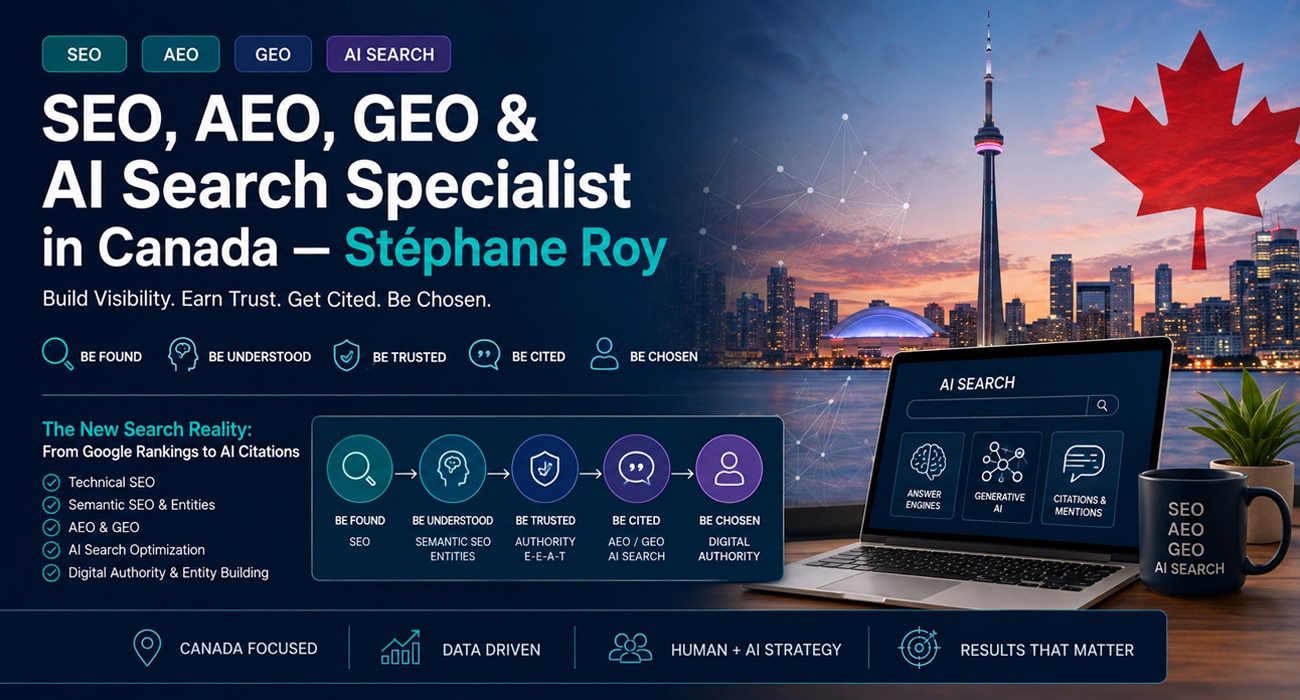
SEO, AEO, GEO & AI Search Specialist in Canada — Stéphane Roy
Helping Canadian Brands Build Visibility Across Search Engines and Generative AI
Helping Canadian businesses become found, understood, trusted, cited and chosen across Google and AI-powered search.
What Is an SEO, AEO, GEO & AI Search Specialist?
An SEO, AEO, GEO & AI Search specialist works across several interconnected layers of digital visibility.
Traditional SEO asks:
Can a search engine find, understand and rank this website?
AEO asks:
Can an answer engine easily extract a reliable answer from this content?
GEO asks:
Can generative AI systems understand, retrieve, reference or cite this business, person or information?
AI Search Optimization brings these disciplines together around a broader objective:
making a person, company, brand or website understandable and discoverable across both traditional and AI-powered search environments.
The objective isn't to abandon Google SEO.
It is to expand the search strategy.
SEO vs. AEO vs. GEO vs. AI Search Optimization
Build discoverability, relevance, crawlability and organic visibility.
Structure information so answer systems can extract useful responses.
Improve entity clarity, retrieval potential and citation-worthiness.
Connect SEO, entities, authority and machine-readable meaning.
Although these disciplines overlap, they solve different parts of the visibility problem.
| DisciplineMeaningPrimary objectiveTypical environments | |||
|---|---|---|---|
| SEO | Search Engine Optimization | Improve organic search visibility | Google, Bing |
| AEO | Answer Engine Optimization | Make information easy to extract as an answer | Featured answers, voice and AI answer systems |
| GEO | Generative Engine Optimization | Increase the ability of generative systems to understand, retrieve and potentially cite content | ChatGPT, Gemini, Perplexity and other generative systems |
| Semantic SEO | Meaning- and entity-oriented optimization | Help machines understand relationships between topics and entities | Search engines, knowledge systems and AI retrieval |
| AI Search Optimization | Optimization for AI-mediated discovery | Improve brand/entity visibility across AI search ecosystems | AI assistants, AI search and generative answers |
These strategies should not exist in isolation.
The strongest approach is usually an integrated one.
SEO creates discoverability.
Semantic SEO creates understanding.
AEO creates answerability.
GEO supports generative retrieval and citation potential.
Digital authority creates trust.
Why Traditional SEO Is No Longer the Whole Search Strategy
Traditional SEO remains essential.
Technical accessibility, crawlability, indexation, internal linking, content quality, backlinks, topical relevance, local signals and site performance still form the foundation of search visibility.
But the user's journey is changing.
Someone researching a service might traditionally search Google for:
SEO specialist Canada
and evaluate ten search results.
Another user might now ask an AI assistant:
Who can help a Canadian company improve its visibility in Google and AI search?
Or:
What type of consultant do I need for SEO, AEO and GEO?
Those are fundamentally different discovery experiences.
In the first case, the objective is primarily to rank.
In the second, the objective is to become an entity or source that a system can confidently retrieve, understand and potentially recommend or cite.
That requires a broader architecture.
From Keywords to Entities
One of the biggest changes in modern search is the growing importance of entities.
An entity can be:
- a person;
- a business;
- an organization;
- a product;
- a location;
- a service;
- a concept.
For example:
Stéphane Roy is an entity.
SEO is a concept.
AEO is a concept.
GEO is a concept.
AI Search Optimization is a concept.
Canada is a geographic entity.
The strategic objective is to create clear, consistent and verifiable relationships between those entities.
Conceptually:
A search strategy built only around repeating keywords misses much of this relationship-based architecture.
Modern search optimization therefore involves helping machines determine:
Who are you?
What do you do?
What subjects are you associated with?
Where do you operate?
What evidence supports those associations?
Which independent sources corroborate them?
My Approach to SEO and AI Search
My approach begins with a principle:
Search visibility should be engineered as an ecosystem.
A website should not consist of isolated pages attempting to rank independently.
Pages, articles, author information, structured data, internal links, external references, geographic signals and professional profiles should reinforce a coherent identity.
I organize this around several layers.
1. Technical SEO
Before attempting advanced AI-search optimization, the website must be technically accessible.
This includes areas such as:
- crawlability;
- indexation;
- canonicalization;
- site architecture;
- internal linking;
- mobile compatibility;
- performance;
- metadata;
- XML sitemaps;
- redirects;
- structured data;
- duplicate-content management.
AI Search Optimization cannot compensate for a fundamentally inaccessible website.
2. Semantic SEO
Semantic SEO goes beyond matching an exact keyword.
The objective is to build a clear network of topics, concepts and relationships.
For example, a comprehensive page about AI Search Optimization might naturally establish relationships among:
SEO → Semantic Search → Entities → AEO → GEO → Structured Data → Digital Authority → AI Retrieval
This creates context.
Instead of publishing dozens of disconnected articles, I prefer building topic ecosystems where supporting pages reinforce larger areas of expertise.
3. Entity Optimization
Entity optimization is especially important when establishing the authority of a person or company.
For a professional, consistent identity signals can include:
- full professional name;
- occupation;
- areas of expertise;
- official website;
- author profiles;
- professional profiles;
- published articles;
- business information;
- geographic market;
- structured data;
- reputable external references.
Consistency matters.
If one platform describes someone as a web designer, another as a photographer, another as an SEO consultant and another as an AI Search specialist, machines have more work to do to resolve the entity's primary professional identity.
This does not mean a multidisciplinary professional must abandon other expertise.
It means that the hierarchy of expertise should be clear.
For my own search positioning, that hierarchy increasingly centers on:
supported by my broader background in web development, digital marketing, visual communication and online strategy.
4. Answer Engine Optimization — AEO
AEO stands for Answer Engine Optimization.
The objective is to make content easy for machines to understand and extract when answering specific questions.
AEO-oriented content generally benefits from:
- clear questions;
- concise direct answers;
- descriptive headings;
- logical hierarchy;
- definitions;
- comparison tables;
- factual language;
- supporting evidence;
- FAQs where genuinely useful;
- structured information.
For example:
What is AEO?
Answer Engine Optimization is the practice of structuring and improving information so that search and AI-powered answer systems can more easily identify, understand and use it when answering a user's question.
The answer is immediately available.
The rest of the section can then provide deeper context.
This structure serves both humans and machines.
5. Generative Engine Optimization — GEO
GEO stands for Generative Engine Optimization.
Instead of focusing exclusively on ranking a URL in a traditional list of search results, GEO considers how information is discovered and synthesized by generative systems.
A GEO strategy can involve:
- strong topical coverage;
- identifiable authorship;
- factual accuracy;
- source transparency;
- entity consistency;
- structured information;
- third-party corroboration;
- citations and references;
- digital authority;
- clear semantic relationships.
There is no legitimate method that guarantees:
Generative systems are dynamic and can use different information sources, retrieval methods and ranking processes.
The realistic objective is to make the entity and its information clearer, stronger, better corroborated and easier to retrieve.
6. Structured Data and Schema
Structured data helps explicitly describe the meaning of a page.
Depending on the page, appropriate Schema.org types can include:
Person
Organization
ProfessionalService
Article
BlogPosting
ProfilePage
BreadcrumbList
and other relevant types.
Structured data is not a magic ranking switch.
Its value is semantic clarity.
For a professional entity, structured data can help express relationships such as:
Person → name → Stéphane Roy
Person → url → official website
Person → sameAs → verified professional profiles
Person → knowsAbout → SEO / AEO / GEO / AI Search
Article → author → Stéphane Roy
The objective is to create a consistent machine-readable graph rather than isolated pieces of markup.
7. Digital Authority Beyond Your Own Website
A website cannot create strong authority entirely by talking about itself.
Independent corroboration matters.
Signals can come from:
- professional profiles;
- industry websites;
- interviews;
- podcasts;
- legitimate directories;
- business associations;
- client references;
- published research;
- media coverage;
- authoritative backlinks;
- professional contributions;
- conference appearances;
- citations by other websites.
This distinction is critical for GEO.
Publishing:
does not make that statement authoritative.
A much stronger strategy is to demonstrate:
- methodologies;
- actual projects;
- measurable results;
- original analysis;
- case studies;
- search experiments;
- documented expertise;
- external recognition.
Evidence builds authority better than adjectives.
Can a Specialist in Québec Work on SEO Across Canada?
Yes.
Many components of SEO are not restricted by the consultant's physical location.
A Canadian SEO strategy can be designed around geographic search markets including:
Montréal
Toronto
Vancouver
Calgary
Ottawa
Halifax
Québec City
or smaller regional markets.
The important factor is not pretending to have a physical office where one does not exist.
The strategy should instead create legitimate geographic relevance through:
- useful regional content;
- service-area architecture;
- market-specific research;
- localized search intent;
- appropriate internal linking;
- legitimate local references;
- language optimization;
- regional terminology;
- customer and project evidence where available.
A consultant can therefore serve organizations across Canada while remaining transparent about where the business is actually located.
Québec Creates a Particularly Interesting AI Search Environment
Québec presents an additional search challenge because businesses frequently operate in both French and English.
Simply translating English SEO content word-for-word is rarely sufficient.
Search intent can differ.
Terminology can differ.
Regional expressions can differ.
Competition can differ.
The information sources used by search and AI systems can also differ by language.
For businesses operating in Québec and elsewhere in Canada, this creates an opportunity to develop an intentional bilingual search architecture.
The objective should be to create meaningful French and English experiences—not duplicate pages generated solely to capture keywords.
How I Evaluate AI Search Visibility
Traditional SEO provides familiar metrics:
- rankings;
- impressions;
- clicks;
- organic sessions;
- conversions;
- backlinks;
- referring domains.
AI Search requires additional forms of measurement.
I look at questions such as:
Entity recognition
When my name or a client's brand is provided, can search and AI systems identify the correct entity?
Topic association
What subjects does the system associate with that entity?
Unprompted discovery
If the name is removed from the question, can the entity still be discovered for relevant professional categories?
Citation visibility
Does the website appear as a source when relevant AI systems provide citations?
Brand mentions
Is the company or professional mentioned even when the website itself isn't directly cited?
Search-to-AI consistency
Are the descriptions found across Google, websites, professional profiles and AI systems reasonably consistent?
These tests provide a more complete picture than a single keyword ranking.
Recognition vs. Retrieval: An Important Distinction
This is one of the most useful concepts in AI Search Optimization. Supplying a person's name tests recognition; removing the name tests whether the category can retrieve the entity independently.
The system understands who you are.
The system connects your name to the desired expertise.
The system can potentially discover you without being given your name.
Your content becomes relevant enough to be referenced.
How Businesses Can Become Easier for AI Systems to Understand
There is no single GEO trick.
A stronger strategy is built from multiple reinforcing signals.
Build a clear entity
Use a consistent company or professional identity.
Establish topical expertise
Create comprehensive content around the subjects for which you genuinely have expertise.
Answer real questions
Publish content corresponding to actual customer and industry questions.
Use structured data correctly
Describe people, organizations, articles and relationships accurately.
Make it clear who created the information and why that person has relevant expertise.
Earn independent references
Build legitimate mentions and links beyond your own domain.
Keep information consistent
Avoid contradictory names, titles, services and company descriptions across the web.
Provide evidence
Case studies, data, examples and original observations can make content considerably more useful.
What AI Search Optimization Is NOT
AI Search Optimization should not become another excuse for manipulation.
It is not:
keyword stuffing for ChatGPT.
It is not:
creating hundreds of nearly identical AI-generated articles.
It is not:
adding “best expert in Canada” everywhere on a website.
It is not:
putting every possible Schema type onto every page.
It is not:
manufacturing fake third-party recommendations.
And it certainly is not a guarantee that an AI platform will recommend a particular company.
A sustainable strategy is based on making information:
useful, identifiable, structured, consistent, authoritative and verifiable.
The Stéphane Roy Search Architecture
My long-term objective for my own digital ecosystem is straightforward.
I want search systems to clearly understand the relationship:
That relationship cannot be created by this article alone.
It must be reinforced across an ecosystem consisting of:
This is the same principle I apply when evaluating search architecture for businesses.
A Practical AI Search Authority Framework
Technical access, search intent, useful content, internal links and authority.
Clear relationships, authorship, structured data and topical context.
Experience, corroboration, case studies and verifiable expertise.
Answer-ready information and stronger opportunities for retrieval and citation.
Turn visibility and trust into qualified consideration.
I summarize the process using four objectives:
BE FOUND
Build the technical and organic foundation that allows search systems to discover the entity and its content.
Technical SEO + crawling + indexation + internal linking + backlinks
BE UNDERSTOOD
Clearly establish what the entity is and what it represents.
Semantic SEO + entities + structured data + consistent information
BE TRUSTED
Provide reasons for search systems and users to consider the information credible.
Experience + evidence + reputation + third-party corroboration + authority
BE CITED AND CHOSEN
Create useful information capable of supporting answers and decisions.
AEO + GEO + useful content + citations + brand authority
The complete model becomes:
Why AI Search Does Not Eliminate SEO
There is a temptation to present GEO as the replacement for SEO.
I don't believe that is a useful way to think about the transition.
AI systems still need information.
Websites still need to be crawled.
Entities still need to be understood.
Sources still need authority.
Content still needs context.
Brands still need reputation.
Search visibility is therefore becoming broader, not disappearing.
The companies that adapt successfully will combine the foundations of traditional SEO with the emerging requirements of AI-mediated discovery.
Who Can Benefit From SEO, AEO and GEO?
This integrated approach can be useful for:
- Canadian SMEs;
- professional services;
- manufacturers;
- tourism businesses;
- e-commerce companies;
- consultants;
- local businesses;
- organizations;
- entrepreneurs;
- professionals building personal authority;
- companies entering new geographic markets.
The precise balance between SEO, AEO and GEO should depend on the organization.
A local contractor does not need the same architecture as a national SaaS company.
A professional building personal authority requires different entity signals than an e-commerce store.
Strategy should follow the business objective—not the acronym.
Frequently Asked Questions
Who is Stéphane Roy in SEO?
Stéphane Roy is a Canadian SEO professional whose work includes technical SEO, semantic SEO, local and geographic search strategy, AEO, GEO, entity-based optimization and AI Search Optimization. His approach combines traditional organic-search fundamentals with strategies intended to improve how businesses and professional entities are understood across emerging AI-powered search environments.
What does an SEO, AEO and GEO specialist do?
An SEO, AEO and GEO specialist works to improve visibility across traditional search engines and emerging answer or generative systems. SEO focuses primarily on organic search visibility, AEO on making information suitable for direct answers, and GEO on improving the clarity, authority and retrievability of content and entities for generative search experiences.
What is an AI Search specialist?
An AI Search specialist studies and optimizes how businesses, people, brands and information are represented across AI-mediated discovery environments. The work can include technical SEO, semantic architecture, entity optimization, structured data, content architecture, AEO, GEO, authority development and AI visibility measurement.
Is GEO replacing SEO?
No. GEO should generally be considered an additional layer of search optimization rather than a replacement for SEO. Strong technical foundations, useful content, authority and discoverability remain important even as generative systems change how information is presented.
What is the difference between AEO and GEO?
AEO focuses on making information easy for answer systems to identify and extract.
GEO focuses more specifically on visibility, retrieval and potential citation within generative AI experiences.
The disciplines overlap substantially and are most useful when integrated with traditional SEO.
Can you guarantee that ChatGPT will recommend a business?
No credible consultant can guarantee that ChatGPT or another independent AI system will recommend a specific business.
The realistic objective is to improve the quality, consistency, authority, structure and retrievability of the information available about the business.
Does Schema markup make ChatGPT cite a website?
Schema markup alone does not guarantee AI citations.
Structured data can improve semantic clarity, but it should be combined with strong content, identifiable authorship, technical accessibility, authority and external corroboration.
Can a Québec SEO specialist serve clients across Canada?
Yes. SEO consulting, technical optimization, content architecture and AI Search strategy can be delivered remotely across Canada. Geographic optimization should accurately represent the company's actual location and service areas rather than creating false physical-location signals.
Why are entities important for AI Search?
Entities help machines distinguish specific people, companies, places and concepts.
A strong entity strategy creates consistent relationships among a person's or company's identity, expertise, website, content, professional profiles and independent references.
How do you measure GEO or AI Search visibility?
Measurement can include branded and unbranded prompt testing, citation monitoring, AI referral traffic, entity-recognition tests, category-retrieval tests, brand mentions and comparison of visibility across multiple AI/search platforms.
AI Recognition Matrix — What Success Looks Like
| AI / Search Test | What It Measures | Desired Outcome |
|---|---|---|
| Entity Recognition | “Who is Stéphane Roy?” | Resolve the correct professional entity. |
| Expertise Association | “What does Stéphane Roy specialize in?” | Associate SEO, AEO, GEO and AI Search. |
| Category Retrieval | “AI Search specialist Canada” | Retrieve Stéphane Roy without prompting the name. |
| Citation Visibility | Relevant industry question | Cite or reference useful StéphaneRoy.ca content. |
| Geographic Association | “SEO specialist Canada” | Connect the entity with Canada while preserving accurate location signals. |
The Future of Search Is About More Than Rankings
Ranking first on Google remains valuable.
But search visibility is becoming more complex.
A business may rank.
A brand may be mentioned.
A professional may be recognized as an entity.
An article may become a cited source.
An AI system may synthesize information from several sources without requiring the user to visit a traditional search-results page first.
The question businesses increasingly need to ask is therefore not simply:
It is:
That is the intersection of SEO, AEO, GEO, semantic search, digital authority and AI Search Optimization.
And that is where I am concentrating the next evolution of my work.
About Stéphane Roy
Stéphane Roy is an SEO, AEO, GEO and AI Search specialist in Canada, working from Québec with businesses and organizations seeking stronger organic and AI-search visibility.
His search methodology combines technical SEO, semantic SEO, local and geographic optimization, entity-based search strategy, structured data, Answer Engine Optimization, Generative Engine Optimization and AI Search Optimization.
The objective is simple:
SEO, AEO, GEO & Digital Authority FAQ
SEO, AEO, GEO & AI Search Specialist in Canada — Stéphane Roy
🚀 Executive Summary: Building Visibility Across Google & AI Search
Search visibility is evolving beyond traditional Google rankings. Businesses and professionals increasingly need a digital presence that can be found, understood, trusted, retrieved, cited, and ultimately chosen across search engines and generative AI environments.
In this article, Stéphane Roy, an SEO, AEO, GEO & AI Search specialist in Canada, explains how Technical SEO, Semantic SEO, Answer Engine Optimization (AEO), Generative Engine Optimization (GEO), Entity Optimization, structured data, Digital Authority, and AI Search Optimization work together to build stronger visibility across Google and emerging AI-powered search experiences.
Technical SEO, crawlability, indexation, content quality, search intent, internal linking, backlinks, local relevance, and structured data create the foundation that allows search systems to discover and evaluate a website.
Semantic SEO and entity optimization help machines understand who a person or business is, what it does, where it operates, which subjects it is associated with, and how those relationships connect across the web.
AEO and GEO focus on clear, useful, structured, authoritative, and verifiable information that can improve answerability, entity retrieval, brand mentions, and potential citation across AI-powered search experiences.
Strong digital authority combines expertise, authorship, evidence, case studies, professional profiles, backlinks, independent references, reputation, and consistent entity signals to help people and search systems evaluate who deserves consideration.
A central concept in the article is the difference between AI recognition and AI retrieval. It is one thing for an AI system to understand who Stéphane Roy is after being given his name. A stronger level of visibility occurs when relevant professional categories such as SEO, AEO, GEO, Semantic SEO, and AI Search in Canada can lead search systems toward the Stéphane Roy entity without his name being supplied first.
The article therefore explores a four-level progression: Entity Recognition → Category Association → Category Retrieval → Authority & Citation. It also explains how structured data, authorship, semantic relationships, professional profiles, independent references, and useful content can reinforce these signals.
The central search-authority framework is: BE FOUND → BE UNDERSTOOD → BE TRUSTED → BE CITED → BE CHOSEN. SEO creates discoverability, semantic SEO and entities create understanding, evidence and external corroboration create trust, AEO and GEO improve answer and retrieval opportunities, and Digital Authority supports consideration and selection.
The long-term entity relationship is clear: Stéphane Roy → SEO → AEO → GEO → Semantic SEO → AI Search Optimization → Canada.