




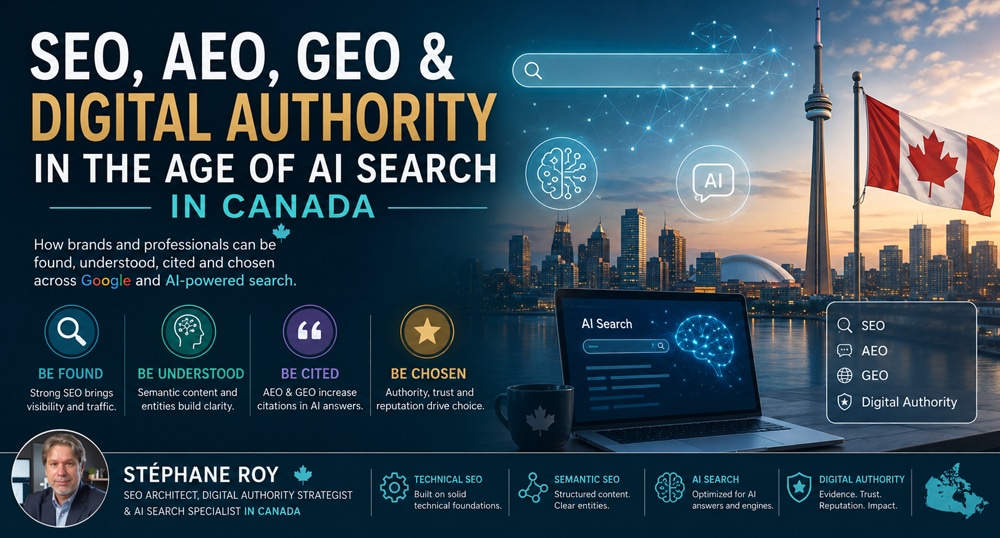
SEO, AEO, GEO & Digital Authority in the Age of AI Search in Canada
SEO, AEO, GEO & Digital Authority in the Age of AI Search in Canada
How brands and professionals can be found, understood, cited and chosen across Google and AI-powered search.
Search is undergoing the most significant transformation since the emergence of Google. For more than two decades, search engine optimization focused primarily on one objective: ranking webpages in search results.
That objective still matters. But in the age of artificial intelligence, ranking is only one part of digital visibility. People increasingly discover businesses, professionals, products and information through a combination of traditional Google results, AI-generated search experiences, answer engines and conversational AI systems.
This creates a new strategic challenge. It is no longer enough for a business or professional to simply rank. They need to become:
That four-stage framework represents my approach to modern SEO, AEO, GEO and digital authority in Canada.
1. BE FOUND
SEO — Search Engine Optimization
The first objective remains visibility. If Google cannot efficiently discover, crawl, understand and index your information, everything that follows becomes more difficult. SEO creates that foundation.
Modern SEO, however, involves considerably more than keywords. It combines technical accessibility, intent, information architecture, entity clarity, content quality, authority and measurement.
A Complete SEO Ecosystem
| SEO Component | Strategic Purpose |
|---|---|
| Technical SEO | Make content accessible, crawlable and indexable. |
| Search Intent | Understand what users actually want and why they search. |
| Semantic Architecture | Establish meaningful relationships between topics, pages and entities. |
| Internal Linking | Connect pages and distribute contextual relevance and authority. |
| Content | Answer real questions and satisfy useful search intent. |
| Topical Authority | Demonstrate depth, consistency and experience around a subject. |
| Backlinks & Citations | Build external discovery and corroboration signals. |
| Local SEO | Establish geographic relevance in Canadian markets. |
| Structured Data | Describe information in machine-readable form. |
| Entity Optimization | Clarify people, organizations, products, services and relationships. |
| UX / Performance | Deliver a useful experience after the click. |
| Measurement | Connect visibility to actual business outcomes. |
2. BE UNDERSTOOD
Semantic SEO + Entity Optimization
Being indexed is not the same as being understood. Search systems increasingly work with entities and relationships, not just strings of keywords.
Consider my own professional entity. The objective is not simply for a search engine to encounter the name Stéphane Roy. The objective is to connect that person to relevant subjects, expertise, tools, geography, work and evidence.
3. BECOME THE ANSWER
AEO — Answer Engine Optimization
Search behaviour has become more conversational. Someone may still type SEO expert Canada, but increasingly they ask complete questions such as:
- Who can help a Canadian company improve its visibility in AI search?
- What is the difference between SEO, AEO and GEO?
- How should a Canadian business prepare for Google AI search?
- Who specializes in semantic SEO and digital authority in Canada?
A strong answer-oriented page makes important information easy to locate, interpret and verify.
| Discipline | Practical Definition | Primary Outcome |
|---|---|---|
| SEO | Improve discoverability, relevance, technical accessibility and organic visibility in search. | Be found in relevant search experiences. |
| AEO | Make information clear, structured and useful for systems that answer questions directly. | Become answer-ready. |
| GEO | Improve how content, brands and entities are represented within generative search environments. | Increase opportunities for inclusion, citation and influence. |
| Digital Authority | Build a coherent evidence ecosystem around identity, expertise, reputation and external corroboration. | Earn trust and consideration. |
4. BE CITED
GEO — Generative Engine Optimization
A foundational 2023 research paper formalized Generative Engine Optimization (GEO) as a framework for improving content visibility in generative-engine responses. The important idea is that generative systems can synthesize information from multiple sources rather than simply return a traditional ranked list.
That changes the strategic question. Instead of asking only “Does my page rank?”, we also ask:
- Does the system understand my expertise?
- Does it recognize my entity?
- Can it verify my claims from reliable evidence?
- Is my content useful enough to cite or incorporate?
- Does my name or brand appear in the right context?
5. YOU CANNOT SCHEMA YOUR WAY INTO AUTHORITY
Structured data matters, but schema describes information—it does not independently prove expertise.
Google’s Article structured-data guidance recommends clearly identifying authors and using appropriate Person or Organization markup, along with a unique author URL or relevant sameAs references. That helps machines disambiguate who created the content.
But declaring:
Person → jobTitle: "SEO Expert" → knowsAbout: "SEO"does not automatically create authority. Authority emerges from consistent relationships across a larger ecosystem:
Digital authority is not what you claim about yourself. It is what your digital ecosystem can demonstrate about you.
6. FROM KEYWORDS TO ENTITIES TO AUTHORITY
| Evolution | Primary Strategic Question |
|---|---|
| Traditional SEO | What keywords should I rank for? |
| Technical SEO | Can search engines efficiently access and understand my website? |
| Semantic SEO | What subjects and relationships does my content establish? |
| Entity SEO | Who or what does this information represent? |
| AEO | Can this information directly answer the question? |
| GEO | Is this information useful within generative search? |
| Digital Authority | Why should this person, brand or source be trusted and considered? |
THE MODERN SEARCH AUTHORITY FRAMEWORK
Technical accessibility, search intent, content architecture, keywords, internal links, backlinks and local relevance.
Entity relationships, topical architecture, Schema.org, authorship, context and knowledge relationships.
Direct answers, original insights, clear sourcing, evidence, expert commentary and machine-readable context.
Trust, reputation, demonstrated experience, case studies, corroboration and brand recognition.
7. WHAT MAKES A SOURCE WORTH CITING?
If the goal is to become visible in search and AI systems, the page itself must practice what it teaches. Instead of simply saying “I am one of Canada’s best SEO professionals”, stronger proof comes from evidence.
| Evidence Type | What It Demonstrates |
|---|---|
| First-hand experience | Actual work, implementation knowledge and real-world judgment. |
| Search results | Reproducible visibility that readers can examine themselves. |
| Case studies | What was changed, why it mattered and what happened. |
| Original frameworks | Distinct thinking, such as BE FOUND → BE UNDERSTOOD → BE CITED → BE CHOSEN. |
| Original analysis | Information that adds value beyond generic summaries. |
| External evidence | Independent corroboration from credible third parties. |
| Clear authorship | Who wrote the content and why that person is qualified to discuss it. |
8. LIVE GOOGLE SEARCH EXAMPLES — VERIFY THE RESULTS YOURSELF
Static screenshots become outdated. Live Google search links let readers examine current results directly.
Disclosure: Google results are dynamic and may vary by location, language, device, personalization and date. These links are provided so readers can independently examine current results rather than rely solely on static screenshots.
9. EXAMPLE: OPTIMIZING STÉPHANE ROY AS AN ENTITY
| Entity Layer | Example |
|---|---|
| Entity | Stéphane Roy |
| Entity Type | Person / SEO professional / multidisciplinary digital professional |
| Primary Subject Associations | Technical SEO, Semantic SEO, SEO Architecture, Local SEO, AEO, GEO, AI Search, Digital Authority, WordPress, WooCommerce |
| Geographic Associations | Quebec, Canada |
| Supporting Experience | Web development, digital marketing, photography, graphic design, content creation, artificial intelligence, automation |
| Owned Evidence | stephaneroy.ca, author pages, original articles, case studies, SEO tools, portfolio, project documentation |
| External Corroboration | Professional profiles, client references, organizations, independent mentions, backlinks, media references and search results |
10. WHAT SHOULD AN AI SEARCH SYSTEM UNDERSTAND ABOUT ME?
A useful personal-brand test is to ask whether the digital ecosystem contains enough reliable information to answer questions such as:
- Who is Stéphane Roy?
- What does Stéphane Roy specialize in?
- What evidence demonstrates his SEO experience?
- What SEO projects has he worked on?
- What is his approach to semantic SEO?
- Does he work with Canadian businesses?
- What does he know about AEO and GEO?
- Does he understand WordPress and WooCommerce?
- Does he have experience with local and geographic SEO?
11. AI SEARCH DOES NOT MAKE SEO OBSOLETE
Quite the opposite. Google’s official generative AI search guidance states that SEO best practices remain relevant because its generative AI features are rooted in core Search ranking and quality systems.
Crawlable, technically sound, useful and accessible content.
Clear topics, relationships, entities and information architecture.
Original information, evidence, expertise and external corroboration.
Stronger opportunities across traditional and generative search experiences.
12. AI CONTENT IS NOT THE STRATEGY
Using AI to generate hundreds of pages is not an AI-search strategy. AI can assist with research, analysis, semantic clustering, competitive intelligence, content architecture, structured data, automation, quality control and optimization.
| AI Can Accelerate | Human Expertise Must Supply |
|---|---|
| Research | Strategy |
| Analysis | Experience |
| Semantic clustering | Judgment |
| Content architecture | Original ideas |
| Automation | Evidence and accountability |
13. BE CHOSEN
This is where SEO finally meets business strategy. Imagine someone searches for an SEO professional in Canada:
They discover me through Google or another search experience.
They understand my work in technical SEO, semantic search, AEO, GEO and digital authority.
They encounter evidence, case studies, references and corroborating signals.
They decide the experience, methodology and evidence justify contact.
Rankings do not pay invoices. Traffic alone does not create a business relationship. Trust does.
14. WHO IS STÉPHANE ROY?
I am Stéphane Roy, an SEO architect and multidisciplinary digital professional based in Quebec, Canada.
My professional background combines decades of creative and marketing experience with website development, technical SEO, semantic architecture, local search, geographic SEO, WordPress, WooCommerce, photography, graphic design and digital marketing.
My work increasingly focuses on the intersection between SEO + Semantic Search + AEO + GEO + AI Search + Digital Authority.
Rather than treating these as isolated tactics, I approach them as components of a larger information ecosystem: one designed to help businesses become easier to discover, easier for machines to understand, better supported by evidence, more likely to be referenced, and ultimately more trusted by the people making decisions.
15. MY VISION OF SEARCH IN 2026 AND BEYOND
SEO is not disappearing. It is becoming more sophisticated.
Match language and demand.
Build depth and useful information.
Establish meaning, relationships and answer-readiness.
Connect identity, expertise, evidence, reputation and trust.
SEO, AEO, GEO & Digital Authority in Canada
Search is no longer simply a competition for ten blue links. It is increasingly a competition for understanding, inclusion, citation and trust.
FOUND. UNDERSTOOD. CITED. CHOSEN.
Stéphane Roy
SEO Architect • Digital Authority Strategist • AI Search Specialist
Quebec, Canada
Technical SEO • Semantic SEO • AEO • GEO • AI Search • Entity Optimization • Digital Authority • Local SEO • Canada SEO • WordPress • WooCommerce
Authoritative References
Google Search Central: Optimizing your website for generative AI features on Google Search.
Google Search Central: Article structured data and author markup best practices.
Research: Aggarwal et al., GEO: Generative Engine Optimization.
SEO, AEO, GEO & Digital Authority FAQ
🔎 What is the difference between SEO, AEO and GEO?
SEO (Search Engine Optimization) focuses on improving a website’s visibility, relevance and authority in organic search results. AEO (Answer Engine Optimization) focuses on structuring information so answer-oriented systems can understand and surface direct responses. GEO (Generative Engine Optimization) focuses on strengthening the visibility and citation potential of content, brands and entities within generative AI search experiences.
In practice, SEO, AEO and GEO increasingly work together rather than replacing one another.
⭐ What is Digital Authority in SEO and AI Search?
Digital Authority is the strength of the evidence surrounding a person, business or brand across the Web. It can include original content, demonstrated expertise, case studies, backlinks, citations, professional profiles, independent mentions, reviews, structured entity information and other corroborating sources.
The objective is not simply to claim expertise, but to create an ecosystem of evidence that supports it.
🇨🇦 How can a Canadian business improve its visibility in AI search?
A Canadian business should begin with strong technical SEO, useful original content, semantic architecture and clearly defined entities.
It should also establish consistent information about its organization, services, expertise and geographic markets, supported by relevant structured data and credible external references.
AI visibility should be treated as an extension of a strong search and digital-authority strategy rather than as a separate shortcut.
🤖 Can SEO help a business appear in ChatGPT, Gemini and other AI search experiences?
SEO can contribute to AI-search visibility because it helps make Web content discoverable, accessible, understandable and authoritative.
However, no SEO professional can guarantee that a specific business will be cited or recommended by ChatGPT, Gemini or another generative system.
The stronger strategy is to build authoritative, well-structured and independently corroborated information that gives search and AI systems better evidence to work with.
🧠 What is Entity SEO and why is it important for AI Search?
Entity SEO focuses on helping search systems understand specific people, organizations, brands, products, services, places and the relationships between them.
Instead of optimizing only for keywords, entity optimization establishes context.
For example, connecting Stéphane Roy with Technical SEO, Semantic SEO, AEO, GEO, AI Search, Digital Authority, WordPress, WooCommerce, Quebec and Canada provides machines with a clearer representation of the professional entity and its areas of expertise.
🧩 Does Schema.org structured data improve SEO, AEO and GEO?
Schema.org structured data helps machines interpret information and relationships more explicitly, including authors, organizations, articles, products, services and breadcrumbs.
It can support semantic clarity, but Schema.org does not independently establish authority or guarantee rankings, AI citations or rich results.
Structured data is most effective when it accurately represents visible content and is supported by a broader ecosystem of trustworthy information.
🔗 What is Semantic SEO?
Semantic SEO focuses on meaning, context and relationships rather than optimizing a page around a single keyword.
It involves creating connected content around topics, subtopics, entities, questions and search intent.
A strong semantic architecture helps search engines understand not only what an individual page discusses, but how that page relates to the broader expertise and information architecture of a website.
🌎 How is SEO in Canada different from a purely local SEO strategy?
A local SEO strategy may concentrate on one city or service area, while a Canada-wide SEO strategy can involve multiple provinces, cities, languages and search markets.
National expansion should not simply duplicate pages and replace city names.
A scalable Canadian SEO architecture should establish legitimate geographic relevance, appropriate search intent and useful content for each market while maintaining a coherent national entity and brand.
⚙️ Is AI-generated content good for SEO?
AI can be extremely useful for research, analysis, semantic clustering, content architecture, automation and optimization, but generating large quantities of content does not automatically create search authority.
Successful content still requires accuracy, originality, experience, editorial judgment and genuine value.
The objective should be to use AI to improve intelligence and productivity, not simply to publish more pages.
👤 Who is Stéphane Roy and what is his approach to SEO, AEO and GEO in Canada?
Stéphane Roy is an SEO architect and multidisciplinary digital professional based in Quebec, Canada.
His approach combines Technical SEO, Semantic SEO, search architecture, local and geographic SEO, WordPress, WooCommerce, AEO, GEO, AI Search and Digital Authority.
His broader background in Web development, digital marketing, photography and graphic design contributes to an approach that treats search visibility as a complete digital ecosystem rather than an isolated ranking exercise.
His modern search framework can be summarized as:
BE FOUND → BE UNDERSTOOD → BE CITED → BE CHOSEN
SEO creates discoverability. Semantic SEO and entities create understanding. AEO, GEO and authority increase citation opportunities. Evidence, reputation and trust help a business or professional become chosen.
About the Author
Stéphane Roy is a Canadian Semantic SEO Consultant, AI Search Strategist, Technical SEO Specialist, and Digital Marketing Consultant specializing in enterprise search visibility, content architecture, structured data, entity optimization, and AI discovery systems.
His work focuses on helping organizations improve visibility across Google Search, Google AI Overviews, ChatGPT Search, Gemini, and other emerging answer engines.
Related Topics
SEO, AEO, GEO & Digital Authority in the Age of AI Search in Canada
🚀 Executive Summary: SEO, AEO, GEO, AI Search & Digital Authority in Canada
Search visibility in 2026 extends far beyond traditional Google rankings. Brands and professionals now need to build a digital ecosystem that can be found, understood, cited, and ultimately chosen across traditional search engines, answer engines, and AI-powered search experiences.
In this article, Stéphane Roy explains how SEO, Answer Engine Optimization (AEO), Generative Engine Optimization (GEO), Semantic SEO, Entity Optimization, AI Search, and Digital Authority work together to improve visibility, machine understanding, citation potential, trust, and business relevance across Canada.
Strong SEO creates the foundation for discoverability through technical accessibility, search intent, semantic architecture, content quality, internal linking, backlinks, local relevance, and structured data.
Modern search systems increasingly interpret entities, relationships, topics, people, organizations, services, and geographic relevance rather than relying only on isolated keyword matches.
AEO and GEO focus on making information clear, authoritative, structured, and useful enough to contribute to direct answers and generative AI search experiences where brands and experts may be mentioned or cited.
Digital Authority connects expertise, original content, case studies, professional identity, backlinks, citations, external corroboration, and reputation to help users and search systems evaluate who deserves consideration and trust.
This article presents a modern framework for SEO in Canada, AEO, GEO, Semantic SEO, Entity SEO, AI Search, structured data, and Digital Authority.
Its central principle is simple: BE FOUND → BE UNDERSTOOD → BE CITED → BE CHOSEN. SEO creates discoverability, semantic architecture creates understanding, AEO and GEO increase citation opportunities, and Digital Authority builds the trust that ultimately drives selection.
The article also includes practical examples involving Google search results, entity optimization, Schema.org structured data, Canadian geographic SEO, AI-generated content, WordPress, WooCommerce, and the professional entity of Stéphane Roy.